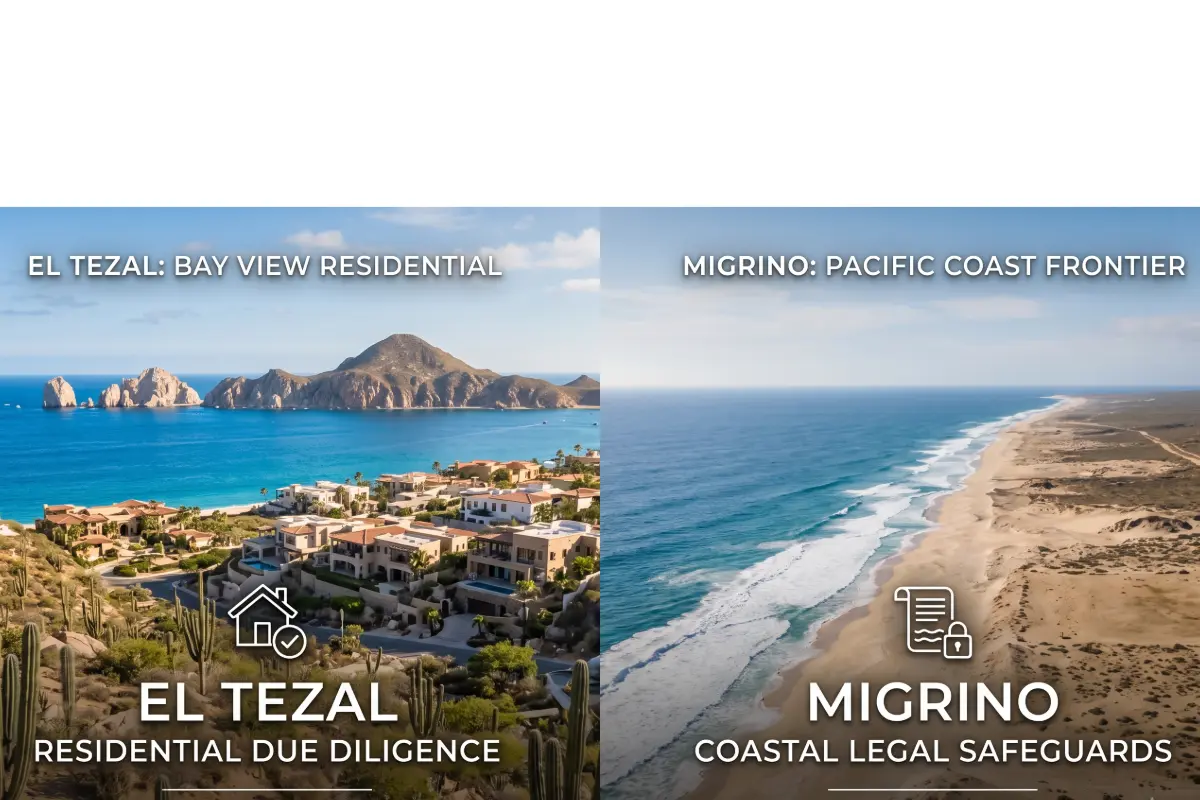
The real estate market in Los Cabos, Baja California Sur, is experiencing a massive growth wave. Foreign investors, expat homebuilders, and commercial developers actively target the region's ocean views, luxury lifestyle, and strong return potential. However, purchasing land in El Tezal versus Migriño involves navigating two distinctly different legal environments.
El Tezal is a rapidly developing urban corridor situated directly above the Transpeninsular Highway in Cabo San Lucas. Here, key legal checks center on municipal zoning limits, building height caps, water hookup feasibility, and HOA covenants.
By contrast, Migriño—located 15 minutes north on the Pacific coast—represents an off-grid land frontier. In Migriño, legal hazards revolve around agrarian communal land (ejido), off-grid water rights, environmental clearances, and coastal setbacks.
Whether you seek a residential lot in El Tezal or an oceanfront parcel in Migriño, executing forensic legal due diligence is the only way to safeguard your capital. Review our comprehensive Los Cabos real estate buyer's guide to understand the local market context, then use this guide to master the legal frameworks, micro-market risks, and essential checks for buying land safely in Baja California Sur.
1. Navigating the Mexican Real Estate Legal Framework
Understanding the Fideicomiso Trust & Foreign Ownership Rights in Los Cabos
A common myth among international buyers is that foreign citizens cannot legally own coastal real estate in Mexico. While Article 27 of the Mexican Constitution restricts direct foreign land ownership within 50 kilometers (31 miles) of the ocean—known as the Restricted Zone—Mexican law provides a secure, battle-tested legal vehicle for ownership: the Fideicomiso.
┌────────────────────────────────────────────────────────────────────────┐
│ MEXICAN RESTRICTED ZONE TRUST (FIDEICOMISO) │
├────────────────────────────────────────────────────────────────────────┤
│ • Property Location: Within 50 km of coastline (El Tezal & Migriño) │
│ • Initial Duration: 50 Years (Indefinitely Renewable by Law) │
│ • Primary Beneficiary: Foreign Individual, Couple, or Entity │
│ • Rights Granted: Full legal rights to build, rent, sell, & inherit │
└────────────────────────────────────────────────────────────────────────┘
How the Fideicomiso Bank Trust Works
A Fideicomiso is a 50-year renewable bank trust established through a licensed Mexican trustee bank. Under this structure:
-
You hold full control: As the named beneficiary, you retain complete operational control over the property. You have the legal right to build, improve, lease, mortgage, sell, or pass the land to substitute beneficiaries (heirs) without entering Mexican probate courts.
-
The Bank acts solely as Trustee: The Mexican bank holds legal title strictly on your behalf. The property does not count as an asset of the bank, meaning your real estate remains completely protected even if the trustee bank encounters financial insolvency.
For a detailed breakdown of trust management and renewal schedules, explore our in-depth Fideicomiso bank trust guide.
Fideicomiso vs. Mexican Corporation
If you plan to buy a lot to build a single-family home, a personal Fideicomiso is the gold standard. However, if your strategy in Migriño or El Tezal involves subdividing acreage, constructing a commercial project, or operating a multi-unit rental development, establishing a Mexican corporation offers distinct operational and tax advantages. Non-nationals can own 100% of a Mexican corporation, allowing the entity to hold direct title to land in the Restricted Zone for commercial ventures.
Obtaining SRE Permits and RFC Registration
Setting up a trust requires your legal team to secure a formal permit from the Secretaría de Relaciones Exteriores (SRE). Additionally, all property owners in Mexico must register for a Mexican Tax ID (RFC - Registro Federal de Contribuyentes) to maintain full tax compliance during ownership and eventual resale.
2. El Tezal Micro-Market Due Diligence: Zoning, Utilities, and HOA Rules
Buying Land in El Tezal: Navigating PDU 2040 Zoning, Water Rights, and HOA Rules
El Tezal sits on the hillsides overlooking Cabo San Lucas, offering spectacular views of Cabo San Lucas Bay and the Land's End arches. Its proximity to downtown makes it one of the busiest residential development zones in Baja California Sur. However, fast-paced urban expansion demands rigorous municipal checks.
Municipal Zoning & The Los Cabos PDU 2040
Before placing earnest money on a lot in El Tezal, verify its secondary zoning designation under the Los Cabos Urban Development Plan (PDU 2040) managed by IMPLAN Los Cabos. Read our overview on the Los Cabos PDU 2040 master plan to understand how secondary zoning classifications dictate building parameters:
-
RT0 (Residential Turístico): Dominates land north of the highway. Designated for single-family homes or low-density developments, with building height limits generally capped at 3 to 4 stories.
-
AT0 (Turístico Hotelero): Predominates on the lower ocean side of the highway. Allows higher-density projects, hotels, or multi-story condominium complexes up to 6 stories.
Legal Warning: Never accept verbal assurances that a lot "allows three or four stories. " Building beyond a lot's authorized Land Occupancy Coefficient (COS) or Land Use Coefficient (CUS) triggers municipal construction halts, heavy fines, and the denial of your final occupancy permit (Terminación de Obra). Always request a written Urban Consultation (Consulta Urbanística) directly from IMPLAN.
Verifying Water Feasibility (Factibilidad de Agua)
Water access represents the single most critical factor when evaluating land in El Tezal. While main municipal lines serve several sub-sectors, others rely on private water delivery trucks (pipas) or private desalination networks.
-
The Rule: Require the seller to provide an official Water Feasibility Letter issued by OOMSAPAS Los Cabos (the municipal water utility). This document confirms that the specific lot holds an allocated municipal connection or an approved hookup quota.
Master Community Bylaws & Condominium Regimes
Lots inside gated subdivisions in El Tezal are governed by a Condominium Regime (Régimen de Condominio). Have your closing attorney review the master deed and HOA bylaws to confirm:
-
The seller is current on all community maintenance fees (backed by a Carta de No Laudo / No-Debt Letter).
-
Architectural height limits, setback requirements, and sightline/view protection covenants.
-
Short-term vacation rental policies (e.g., whether Airbnb hosting is permitted or prohibited).
3. Migriño Micro-Market Due Diligence: Ejido Frontier & Off-Grid Laws
Buying Land in Migriño: Avoiding Ejido Scams, Dominio Pleno, and Coastal Rules
Migriño features vast desert- and ocean-view acreage, expansive beaches, and rolling coastal terrain along Baja's Pacific corridor. It attracts buyers seeking private ranch estates, off-grid eco-villas, or long-term land banking. However, because Migriño is rural, land tenure laws differ fundamentally from urbanized El Tezal.
The Ejido Risk: Cesión de Derechos vs. Private Title
The single largest legal pitfall in Migriño is purchasing Ejido Land. An ejido is a communal land ownership system governed by the Registro Agrario Nacional (RAN) under Mexican agrarian law. Ejido land belongs to the community (ejidatarios) collectively and cannot be directly sold to private individuals or foreign citizens.
-
The Trap: Unscrupulous sellers often market raw land in Migriño using internal documents like a Possession Certificate (Constancia de Posesión) or Assignment of Rights (Cesión de Derechos).
-
The Legal Reality: These internal documents grant temporary occupancy rights within the agrarian community—not legal property title. An assignment of rights cannot be placed into a Fideicomiso, cannot be registered at the Public Registry of Property (RPP), and leaves the buyer exposed to land reclamation lawsuits by the Ejido Assembly.
The Dominio Pleno Privatization Process
For ejido land to become eligible for foreign or private ownership, it must complete a formal privatization process known as Dominio Pleno (Full Ownership). Read our complete guide on converting ejido land to private title to understand the steps involved:
|
Privatization Stage |
Required Legal Action |
Governing Authority / Output |
|
Stage 1: Assembly Approval |
Formal vote by the Ejido Assembly authorizing privatization. |
Asamblea Ejidal minutes recorded with RAN. |
|
Stage 2: Agrarian Certificate |
Issuance of individual agrarian title certificates. |
Registro Agrario Nacional (RAN). |
|
Stage 3: First-Refusal Notice |
Formal written notice to co-owners, family, & municipality (Derecho del Tanto). |
Legal notification receipts. |
|
Stage 4: Public Registration |
Conversion into Private Property (Escritura Pública). |
Formalized before a Notario & recorded in the RPP. |
Critical Takeaway: Never pay the full purchase price for land that is still undergoing the Dominio Pleno process. Only sign binding contracts and transfer funds once the land has exited the agrarian system and holds a registered Escritura Pública at the Public Registry of Property.
Federal Maritime Zone (ZOFEMAT) & Environmental Permits
When evaluating Pacific beachfront or coastal lots in Migriño:
-
ZOFEMAT Setback: The first 20 meters inland from the high-tide line is public land controlled by the federal government (Zona Federal Marítimo Terrestre). Private property titles end at the ZOFEMAT boundary. Building permanent structures near the water requires a federal concession permit from the government.
-
Environmental Impact Assessment (MIA): Rural construction in Migriño frequently requires an Environmental Impact Statement (Manifestación de Impacto Ambiental) submitted through the SEMARNAT Environmental Permitting Portal before clearing native desert vegetation or building access roads.
Off-Grid Infrastructure & Access Rights
Most parcels in Migriño operate off-grid, utilizing solar energy, water truck delivery, or private wells.
-
Water Concessions: Drilling a private water well requires a formal water extraction concession title issued by the CONAGUA National Water Commission.
-
Access Road Easements (Servidumbre de Paso): Verify that the lot deed includes a legally recorded, perpetual right-of-way easement. Landlocked parcels without recorded public access easements frequently trigger legal disputes with surrounding landowners.
4. The 7-Step Forensic Due Diligence Checklist
Execute this step-by-step legal protocol with an independent real estate attorney before closing on land in El Tezal or Migriño.
1
Confirm Titled Private Status
Step 1: RPP Audit
1. Confirm Titled Private Status: Step 1: RPP Audit.
Verify that the land possesses a valid Escritura Pública registered at the Registro Público de la Propiedad (RPP BCS). Confirm that the legal description, plot dimensions, and cadastral key (Clave Catastral) match the physical property site.
2
Perform a 20-Year Title Chain Audit
Step 2: Tracto Sucesivo
2. Perform a 20-Year Title Chain Audit: Step 2: Tracto Sucesivo.
Perform a historical title chain search (Tracto Sucesivo) covering at least 20 years. If the land originated as ejido property in Migriño, verify that all Dominio Pleno procedures and Derecho del Tanto notices were legally executed.
3
Obtain a Certificate of No Liens.
Step 3: Lien Search
3. Obtain Certificate of No Liens: Step 3: Lien Search.
Request an official Certificado de Libertad de Gravamen directly from the RPP. This official document proves that the land is free of active mortgages, tax liabilities, or judicial encumbrances.
4
Validate Zoning & Utility Rights
Step 4: Municipal Check
4. Validate Zoning & Utility Rights: Step 4: Municipal Check.
In El Tezal, verify IMPLAN PDU zoning limits and secure an official OOMSAPAS water feasibility letter. In Migriño, confirm off-grid infrastructure rights and CONAGUA well concession status where applicable.
5
Commission an Independent Property Survey
Step 5: Topographic Survey
5. Commission an Independent Property Survey: Step 5: Topographic Survey.
Hire an independent licensed topographer (Topógrafo) to physically verify plot boundaries using GPS coordinates. Confirm that physical boundary lines match the exact measurements written in the registered deed.
6
Set Up Third-Party Escrow & SRE Permit
Step 6: Escrow Protection
6. Set Up Third-Party Escrow & SRE Permit: Step 6: Escrow Protection.
Never send deposit funds directly to a seller or agent's personal account. Deposit earnest money into a neutral third-party escrow account. Your attorney will submit your foreign ownership permit application to the SRE.
7
Execute Title Before a Notario Público
Step 7: Final Closing
7. Execute Title Before a Notario Público: Step 7: Final Closing.
The transaction is finalized before an official Notario Público—a legal officer appointed by the state governor who verifies title validity, calculates acquisition taxes (ISAI), executes the trust deed, and submits the final deed to the RPP.
5. Financial Realities, Red Flags, and Closing Costs
Calculated Risks: Red Flags and Buyer Closing Costs in Baja California Sur
Understanding acquisition costs and red flags ensures complete financial security throughout property negotiations.
Major Red Flags to Avoid
-
🚩 Direct Cash Demands: Any seller requesting direct cash payments or unrecorded wire transfers to an ejido official or personal bank account.
-
🚩 Absence of Escrow: Sellers or brokers refusing to utilize an independent third-party escrow account for earnest deposits.
-
🚩 Unrecorded Access Roads: In rural Migriño, relying on informal dirt tracks across private land without a recorded legal easement (servidumbre de paso).
-
🚩 Bypassing the Notario: Suggestions to complete the sale using "private contracts" (Contratos Privados) without formal Notario Público involvement.
Buyer Closing Cost Breakdown
In Baja California Sur, buyers should budget 5% to 7% of the purchase price for total closing costs. Use our interactive Los Cabos closing cost calculator to estimate your exact closing budget based on purchase price.
|
Expense Category |
Average Fee Range |
Paid To / Purpose |
|
Acquisition Tax (ISAI) |
~2% – 3% of assessed value |
Local Municipal Treasury. |
|
Notary & Legal Services |
1.5% – 2.5% |
Notary Public & independent buyer attorney fees. |
|
Fideicomiso Setup & SRE Permit |
~$2,000 – $3,500 USD total |
Bank trustee setup fees & Ministry of Foreign Affairs permits. |
|
RPP Deed Registration |
~0.5% – 1% |
Public Registry of Property recording fees. |
|
Survey & Escrow Management |
~$1,000 – $2,000 USD |
Independent surveyor and secure escrow account administration. |
6. Frequently Asked Questions (FAQs)
Frequently Asked Questions: Buying Land in El Tezal and Migriño
Q1: Can a US or Canadian citizen legally buy land in Migriño?
Yes. As long as the land is privately held property holding an Escritura Pública registered at the Public Registry of Property (RPP), foreign citizens can legally acquire and hold title through a Fideicomiso bank trust or a Mexican corporation. If the parcel is un-privatized ejido land, it cannot be legally purchased by foreigners until the Dominio Pleno process is completed.
Q2: How long does the land purchase and trust setup process take in Los Cabos?
A standard land acquisition in Los Cabos typically takes 45 to 90 days from signing the Purchase and Sale Agreement to final registration at the RPP.
Q3: Is an oral agreement or informal receipt from an Ejido president legally binding?
No. Informal receipts (constancias) or verbal promises carry zero legal weight under Mexican civil law for transferring private property title. Only deeds executed before a Notario Público and recorded in the RPP provide legally enforceable property rights.
Q4: What is the main operational difference when building in El Tezal versus Migriño?
In El Tezal, building focus centers on municipal zoning compliance (PDU heights), HOA design rules, and securing municipal water connections. In Migriño, building focus shifts to off-grid engineering: installing solar systems, securing water delivery or well permits (CONAGUA), and adhering to environmental clearances (SEMARNAT/MIA).
Q5: Who pays for the closing costs and property taxes during a land transaction in Los Cabos?
In Baja California Sur, custom dictates that the buyer pays the acquisition tax (ISAI), notary fees, trust setup fees, and registration costs. The seller is legally responsible for paying Capital Gains Tax (ISR - Impuesto sobre la Renta) and clearing any unpaid municipal property taxes (predial) prior to closing.
Conclusion & Call to Action
Protect Your Real Estate Capital in Los Cabos
Buying land in El Tezal and Migriño presents extraordinary real estate opportunities—whether you envision a luxury bay-view home in El Tezal or an off-grid coastal sanctuary in Migriño. However, capitalizing on these high-growth markets requires navigating local real estate regulations with total precision.
By prioritizing titled private property (Escritura Pública), setting up a Fideicomiso bank trust, verifying municipal zoning and water rights, and working exclusively with recognized members of AMPI (Mexican Association of Real Estate Professionals), you can complete your land purchase with complete peace of mind.
Ready to Secure Your Los Cabos Land Investment?
Do not attempt to navigate land titles, zoning audits, or ejido verifications alone. Partner with an AMPI-certified agent and experienced real estate legal counsel before signing contracts or transferring earnest money. Today, contact our real estate legal team to schedule a consultation and audit your prospective land purchase!