
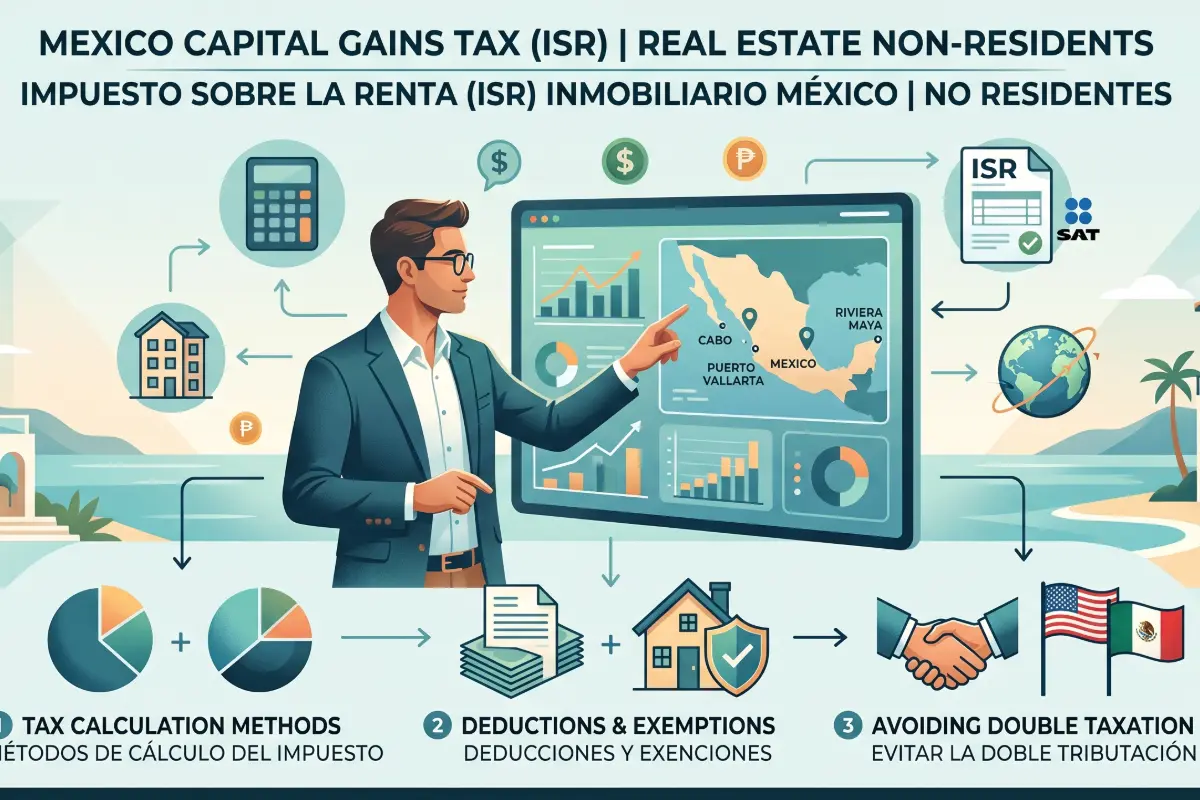
Selling real estate in Mexico as a foreign non-resident offers exceptional financial returns. World-class destinations like Los Cabos, San Miguel de Allende, Puerto Vallarta, and the Riviera Maya consistently attract international home buyers and investors. However, when you decide to sell, Mexico’s Capital Gains Tax (Impuesto Sobre la Renta or ISR) can take a significant bite out of your net profit if you do not plan ahead.
Unlike real estate sales in North America or Europe, where sellers self-report capital gains during annual tax filings, Mexico enforces an immediate tax withholding at closing. A state-appointed legal official, known as a Notario Público, computes, collects, and remits this tax directly to the Mexican government.
If you are a non-resident foreign seller, navigating this system without a clear strategy can trigger severe tax penalties, lost exemptions, or massive unnecessary withholdings at the closing table. This guide breaks down the statutory rules under Article 161 of the Mexican Income Tax Law, compares your tax calculation methods, exposes the "phantom exchange rate gain" trap, details allowable deductions, and explains how to claim cross-border tax credits to protect your wealth.
Decoding Mexican Capital Gains Tax (ISR) for Non-Resident Sellers
Mexican tax law treats all real estate transfers within Mexican territory as Mexican-source income. Consequently, any profit you realize from selling real property in Mexico triggers a mandatory Impuesto Sobre la Renta (ISR) tax obligation.
The Legal Framework: LISR Article 161
Title V, Article 161 of the Ley del Impuesto sobre la Renta (LISR) governs foreign individuals and entities who do not qualify as Mexican tax residents. The law dictates that because the physical asset sits on Mexican soil, the income generated from its sale remains fully taxable under Mexican jurisdiction, regardless of:
-
Where you hold primary citizenship.
-
Where you currently maintain your primary home.
-
Which foreign bank account receives the final wire transfer.
The Closing Enforcer: Why the Notario Público Withholds Your Tax
In Mexican real estate transactions, the Notario Público acts as an official officer of the state, not a simple escrow agent. The Servicio de Administración Tributaria (SAT) holds the Notario jointly and personally liable (responsabilidad solidaria) for calculating and remitting your ISR withholding at closing.
Because notarios face heavy personal fines and potential license revocation if they under-withhold taxes, they enforce tax rules with extreme rigor. They meticulously audit every purchase contract, tax invoice (factura), appraisal, and residency document before approving any deduction or tax exemption. Reviewing a Mexican real estate closing costs breakdown before listing helps ensure you anticipate every fee involved.
Immigration Status vs. Tax Residency: FMM Tourist vs. RFC Holders
Many foreign property owners incorrectly assume that holding a Mexican visa automatically establishes tax residency. Mexican tax law draws a sharp line between immigration status and tax status:
|
Document / Visa Status |
Tax Residency Classification |
Primary Residence Exemption Eligibility |
|
Tourist Card (FMM) |
Non-Resident for Tax Purposes (Title V) |
Ineligible |
|
Temporary Resident |
Non-Resident unless an active RFC & tax address exist |
Conditional (Requires active RFC + 36-month utility proof) |
|
Permanent Resident |
Eligible for Tax Resident status upon SAT RFC registration |
Eligible (With active RFC + qualifying utility proof) |
Holding a temporary or permanent residency visa card alone does not grant you domestic tax-registered status. To access standard progressive tax brackets or claim primary residence exemptions, you must hold an active RFC (Registro Federal de Contribuyentes) linked to a registered Mexican tax address. If you own property through a Fideicomiso bank trust, establishing your tax profile early is critical.
25% Gross Sales vs. 35% Net Profit: Which ISR Calculation Saves You More?
Under Article 161 of the LISR, non-residents can choose between two primary methods to calculate ISR withholding at closing. The Notario Público evaluates your documentation to apply the method that produces the legally correct—and most advantageous—tax outcome.
Option A: 25% Flat Tax on Total Sales Price
This method applies a flat 25% tax directly to the total contract sale price, with zero deductions permitted.
$$\text{ISR Liability} = \text{Gross Sale Price} \times 0.25$$
-
When to use it: Option It benefits sellers who lack official documentation proving their original purchase price, lack valid tax invoices (facturas) for past renovations, or experienced such high appreciation that deducting the original basis provides minimal relief.
Option B: Up to 35% Tax on Net Capital Profit
This method applies a progressive tax rate—capping at 35%—strictly to your net capital profit. You determine net profit by subtracting allowable, fully documented deductions from your adjusted purchase price.
$$\text{ISR Liability} = (\text{Gross Sale Price} - \text{Adjusted Cost Basis} - \text{Allowable Deductions}) \times \text{Applicable ISR Rate}$$
-
When to use it: Option B works best when you maintain an impeccable accounting trail, including your original purchase deed (escritura), inflation adjustments, official electronic tax invoices (CFDI facturas) for renovations, closing costs, and broker commissions. You can estimate your net liability beforehand using a Mexico capital gains tax calculator.
Side-by-Side Comparison: $500,000 USD Case Study
Here is how both options play out for a foreign non-resident selling a home in Cabo San Lucas for $500,000 USD ($10,000,000 MXN at an exchange rate of 20.00 MXN/USD):
|
Financial Variable |
Option A (25% Gross Tax) |
Option B (35% Net Profit Tax) |
|
Gross Sales Price |
$10,000,000 MXN ($500k USD) |
$10,000,000 MXN ($500k USD) |
|
Original Cost Basis (Adjusted) |
Not Allowed |
-$6,000,000 MXN |
|
Documented Renovations (CFDIs) |
Not Allowed |
-$1,000,000 MXN |
|
Broker Commission & Closing Fees |
Not Allowed |
-$500,000 MXN |
|
Taxable Base |
$10,000,000 MXN |
$2,500,000 MXN |
|
Tax Rate Applied |
25% Flat Rate |
~35% Top Bracket |
|
Total ISR Tax Payable |
$2,500,000 MXN ($125,000 USD) |
$875,000 MXN ($43,750 USD) |
|
Net Tax Savings |
Baseline |
$81,250 USD Saved (65% Reduction) |
Option B delivers massive tax savings, provided you support your acquisition costs and capital improvements with official SAT-compliant electronic invoices (facturas).
The Phantom Gain Trap: How Currency Conversion Inflates Your Mexican Taxes
Foreign sellers often face a shocking surprise during tax calculations: the Currency Exchange Rate Trap (or "Phantom Gain").
Why Banco de México Official Exchange Rates Dictate Your Capital Gain
Mexican tax law does not recognize US dollars or Canadian dollars for official accounting. Every property transaction must be calculated and recorded in Mexican Pesos (MXN) using the official exchange rates published by the Diario Oficial de la Federación (DOF) and Banco de México on the day of closing.
If the Mexican peso depreciates against your home currency between your purchase date and sale date, your property’s value in pesos rises automatically—generating a taxable gain in Pesos even if your property value in US dollars remains flat.
Real-World Scenario: Zero USD Profit, $2 Million MXN Taxable Gain
Purchased in 2016: $400,000 USD @ 15.00 MXN/USD = $6,000,000 MXN Basis
Sold in 2026: $400,000 USD @ 20.00 MXN/USD = $8,000,000 MXN Gross Sale
Result in USD: $0 Capital Gain (Broke Even)
Result in MXN: +$2,000,000 MXN Taxable Capital Gain!
Even though you made zero profit in US dollars, SAT sees a $2,000,000 MXN capital gain, triggering an ISR tax obligation of up to $700,000 MXN (~$35,000 USD).
Mitigating Currency Distortions with the INPC Inflation Index
To soften the impact of currency shifts and inflation, Mexican law permits your notario to adjust your original purchase basis using the National Consumer Price Index (Índice Nacional de Precios al Consumidor, or INPC). Longer ownership periods yield higher inflation adjustment coefficients, which increase your cost basis and lower your taxable profit.
Maximizing Deductions: The Mexican SAT "CFDI Factura" Compliance Rules
If you choose Option B (35% Net Capital Gain), you must present legally verifiable deductions. SAT enforces a strict rule: paper receipts, handwritten quotes, bank transfer slips, and foreign invoices carry zero legal weight. Every expense must be backed by an official Mexican electronic invoice carrying a digital seal, known as a CFDI factura (Comprobante Fiscal Digital por Internet).
The 5 Tax-Deductible Line Items Allowed under Option B
-
Original Purchase Basis (Costo Comprobado de Adquisición):
-
The purchase price declared in your original public deed (escritura pública) or bank trust (fideicomiso), converted to MXN at the official rate on your purchase date.
-
Capital Improvements & Renovations:
-
Structural expansions, swimming pools, boundary walls, remodeling, or HVAC replacements.
-
Requirements: You must hold a valid CFDI factura issued by a licensed Mexican contractor featuring your RFC, along with an updated municipal construction permit (manifestación de obra) from the local town hall (Ayuntamiento).
-
Acquisition Taxes & Notary Fees:
-
Legal fees, appraisal fees, and local Real Estate Transfer Tax (ISAI) paid during your original property acquisition.
-
Real Estate Commissions:
-
Broker fees paid at closing.
-
Requirements: The real estate agency must issue an official CFDI factura displaying your name, RFC, and the 16% Value Added Tax (IVA) breakdown.
-
Closing Appraisals & Legal Fees:
-
Official tax appraisal fees (avalúo fiscal) required for closing, along with legal representation fees tied directly to the sale.
If you paid a contractor in cash or received informal paper receipts for a $50,000 USD renovation, SAT will disallow that deduction entirely. You will pay up to 35% ISR on that unevidenced amount. Securing RFC registration for foreign property owners ahead of time ensures your contractors can issue valid invoices.
Primary Residence Tax Exemption: How Foreign Sellers Can Exempt Up to 700,000 UDIs
Under Article 93, Fraction XIX of the LISR, individuals selling their primary residential home in Mexico can claim an ISR exemption up to 700,000 UDIs (Unidades de Inversión).
The 700,000 UDI Threshold (~$6.16M MXN)
UDIs represent inflation-indexed monetary values tracked daily by Banco de México's official UDI rates.
-
Average UDI Value: ~$8.80 MXN
-
Exemption Cap (700,000 UDIs): Approximately $6,160,000 MXN (~$308,000–$315,000 USD depending on daily exchange rates).
The 4 Non-Negotiable Rules to Qualify as a Foreigner
Notarios will grant the Article 93 primary residence exemption to foreign nationals only when they fulfill all four requirements:
-
Legal Residency Status: You must hold active temporary or permanent residency status. Tourist cards (FMM) are strictly excluded. Following a structured Mexican residency visa guide ensures your legal standing is clear.
-
Active RFC Tax ID: You must hold an active RFC registered with SAT and maintain an up-to-date Constancia de Situación Fiscal.
-
Exact Address Utility Proof: You must present 36 consecutive months of CFE electricity bills, Telmex landline bills, or Mexican bank statements.
-
The Critical Rule: Your utility bills must display your RFC, and the address on the bills must match your property deed 100% word-for-word (street name, exterior/interior numbers, colonia, and postal code). Any spelling variation gives the Notario cause to reject the exemption.
-
3-Year Frequency Limit: You can only claim the primary residence capital gains exemption once every 3 calendar years.
Partial Exemptions for High-Value Homes
If your property sells for more than 700,000 UDIs ($6.16M MXN), you do not lose the exemption. You receive a proportional exemption: the first ~$6.16M MXN of value remains completely tax-free, and you pay ISR only on the proportional profit above that threshold.
Cross-Border Tax Strategy: Claiming Foreign Tax Credits in the US and Canada
Paying capital gains tax in Mexico does not relieve you of tax reporting duties in your home country. Both the US and Canadian governments tax their residents on worldwide income, but cross-border tax treaties prevent double taxation when applied properly.
US Citizens: IRS Form 8949, Schedule D, and Form 1116 Foreign Tax Credit
US citizens and green card holders must report foreign real estate sales on IRS Form 8949 and Schedule D.
-
IRS Form 1116 (Foreign Tax Credit): Review the IRS Foreign Tax Credit Compliance Guidelines and complete IRS Form 1116 Foreign Tax Credit to claim the ISR tax paid in Mexico as a dollar-for-dollar credit against your US tax liabilities. Because Mexican ISR rates (up to 35%) typically exceed US long-term capital gains rates (15%–20%), this credit often eliminates your US tax liability on the transaction.
-
Section 121 Primary Residence Exclusion: If you occupied the Mexican property as your primary home for at least 2 of the 5 years prior to the sale, you can combine the IRS Section 121 exclusion ($250,000 USD single / $500,000 USD married) with your foreign tax credit strategy.
Canadian Residents: CRA Schedule 3 and Form T2209 Tax Credits
Canadian tax residents must declare foreign property sales on Schedule 3 of their T1 tax return, along with Form T1135 if the asset's cost basis exceeded $100,000 CAD.
-
Form T2209 (Federal Foreign Tax Credits): Submit Canada Revenue Agency Form T2209 following the official CRA Line 40500 Federal Foreign Tax Credit guide. This step allows you to credit Mexican ISR directly against Canadian taxes payable, neutralizing double taxation.
Step-by-Step Pre-Listing Seller Tax Audit Roadmap
Execute this 4-week audit workflow before listing your property to protect your net proceeds at closing:
1. Gather Original Deed Documents: Week 1.
Locate your original purchase deed (escritura pública) or bank trust (fideicomiso). Confirm the purchase price in pesos and record the official exchange rate from your purchase date.
2. Audit CFDI Facturas & Construction Records: Week 2.
Collect all electronic tax invoices (CFDI facturas) for renovations and capital improvements. Ensure your construction manifestation (manifestación de obra) is filed with the local town hall.
3. Verify RFC & Utility Bill Alignment: Week 3.
Download your current Constancia de Situación Fiscal from SAT. Confirm that your CFE electricity bills display your RFC and match the property address on your deed character-for-character.
4. Request a Pre-Closing Estimate from a Notario: Week 4.
Submit your document binder to a licensed Notario Público for a formal tax projection comparing the 25% gross and 35% net profit calculation methods.
Frequently Asked Questions (FAQ)
Can I legally lower my capital gains tax when selling property in Mexico?
Yes. You can lower or eliminate ISR legally by claiming the primary residence tax exemption under Article 93 of the LISR or by utilizing Option B (35% Net Profit) with fully compliant CFDI facturas to offset your capital gain.
What happens if I sell Mexican property without an RFC tax ID?
Without an active RFC, the Notario Público must classify you as a non-resident seller under Title V. You will forfeit eligibility for the primary residence tax exemption and face a mandatory 25% flat tax on the gross sale price if your deduction receipts are incomplete.
Are real estate commissions deductible for capital gains tax in Mexico?
Yes. Real estate broker commissions are fully deductible under Option B (Net Profit), provided your broker issues an official electronic CFDI factura displaying your name, RFC, and the 16% Value Added Tax (IVA) breakdown.
What can I do if I renovated my property without collecting CFDI facturas?
If you completed work without CFDI invoices, hire a certified municipal appraiser (perito valuador) to conduct a retrospective construction appraisal. Once registered with the local town hall as an official manifestación de obra, thnotaryio can recognize a portion of the structural cost basis.
Protect Your Real Estate Equity Today
Selling property in Mexico should represent a lucrative financial milestone, not an expensive lesson in foreign tax rules. Strict notary liability, currency exchange traps, and precise CFDI invoice rules make proactive tax planning essential.
Over 60% of foreign sellers pay more capital gains tax than legally required simply because their renovation invoices lack proper digital seals or their utility bills fail to match their deed address. Missing even one small detail can instantly void thousands of dollars in legitimate deductions.
Take control of your transaction before putting your home on the market. Schedule a comprehensive cross-border real estate tax consultation today to audit your deeds, verify your invoices, and lock in the most tax-efficient closing strategy.