
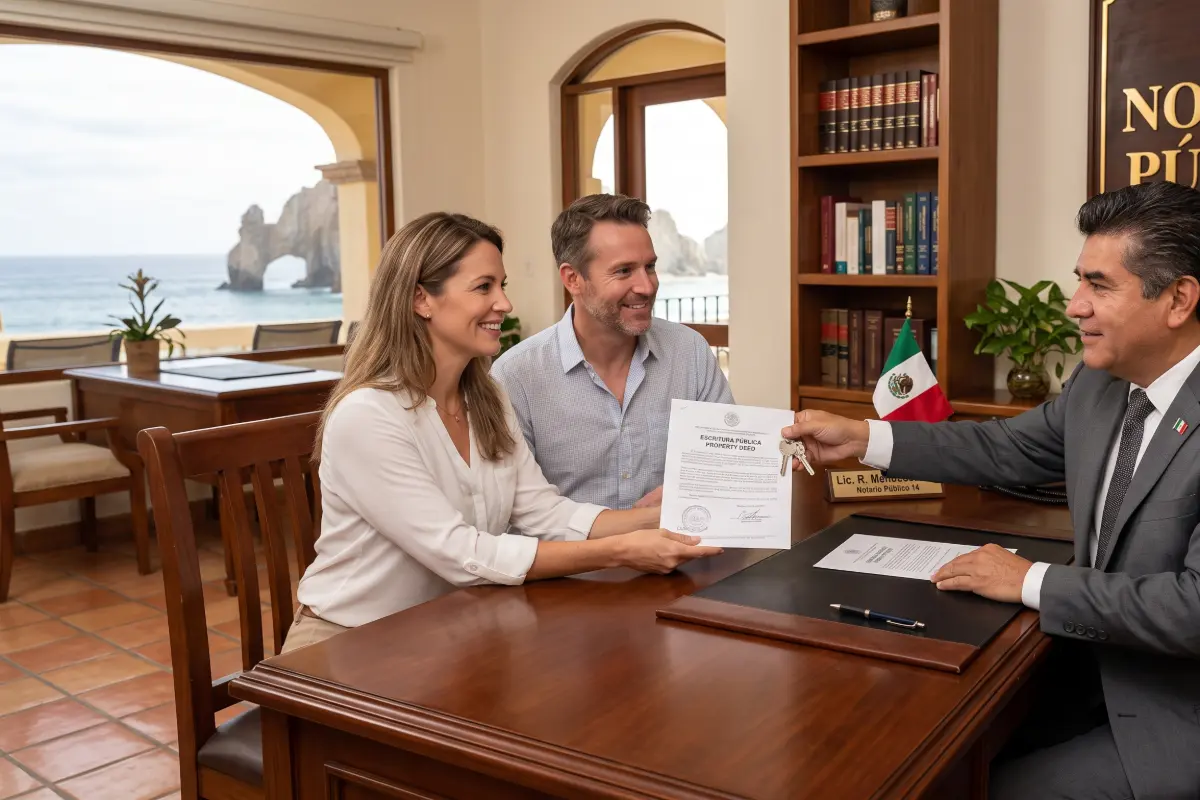
Imagine securing your ideal beachfront villa in Los Cabos, a historic courtyard residence in San Miguel de Allende, or a modern condo in the Riviera Maya. Your purchase offer is accepted, enthusiasm builds, and then you enter the legal closing stage.
Navigating property transactions in a foreign legal system can feel daunting.
The most common—and expensive—mistake foreign buyers make is treating a Mexican Notario Público like a notary public in the U.S. or Canada. In common law systems, a notary simply verifies identities and witnesses signatures. In Mexico, a Notario Público is a senior, governor-appointed legal officer who carries strict financial and legal liability for authenticating property title transfers.
Mastering the role of the notary public in Mexico and following the steps to a secure closing will safeguard your capital and guarantee peace of mind.
This guide breaks down the essential duties of a Mexican Notary Public, how title security works in restricted coastal zones, what closing fees cover, and how to structure your transaction for maximum protection.
1. U.S. vs. Mexican Notary Public: The Critical Legal Difference
In Mexico, becoming a Notario Público requires a law degree, years of specialized legal practice, competitive state examinations, and an official appointment from the state governor.
Because Mexico uses a civil law framework, legal instruments certified by a notary carry the presumption of public truth (fe pública).
|
Feature |
U.S. / Canadian Notary Public |
Mexican Notario Público |
Independent Buyer's Attorney |
|
Primary Role |
Verifies ID & witnesses signatures |
Authenticates title, calculates taxes, drafts & records public deeds |
Protects the buyer's private commercial interests |
|
Qualifications |
Basic state license / non-attorney |
Senior attorney appointed by state governor |
Licensed real estate attorney |
|
Impartiality |
Neutral signature witness |
Neutral officer of the state |
Dedicated advocate for the buyer |
|
Legal Liability |
Minimal / Bonded |
Personally liable for tax & title errors |
Professional liability to the client |
|
Key Deliverable |
Notarized signature stamp |
Registered Escritura Pública (Title Deed) |
Verified contracts & title due diligence |
The Impartiality Rule:
The notary public represents neither you nor the seller. They act as an impartial government officer enforcing tax codes, verifying clear title, and ensuring full statutory compliance. To negotiate contract terms and safeguard your specific financial interests, you should retain an independent buyer's real estate attorney.
2. What Does a Mexican Notary Public Actually Do? (6 Core Duties)
Once you sign a purchase agreement, the notary public steps in as the primary legal authority guaranteeing the validity of the sale.
The notary executes six vital duties behind the scenes:
-
Auditing Property Title: They review previous deeds (escrituras) to confirm the seller holds legal authority to transfer the property free of claims or defects.
-
Obtaining Official Clearances: They request a Certificado de Libertad de Gravamen (Certificate of No Encumbrances) from the Gob.mx Public Registry of Property framework alongside municipal certificates proving property taxes (predial) and water bills are current.
-
Filing the Preventive Notice (Aviso Preventivo): They register a formal notice at the Public Registry to freeze the title, preventing secondary sales, mortgages, or unexpected liens during closing.
-
Calculating and Withholding Taxes: They compute the buyer's Acquisition Tax (ISAI) and withhold the seller's Capital Gains Tax (ISR) for direct payment to the Servicio de Administración Tributaria (SAT).
-
Verifying Financial Compliance: Under Mexico's Federal Anti-Money Laundering Law (LFPIORPI), the notary verifies the buyer's and seller's tax IDs (RFC) and validates the bank origin of all purchase funds.
-
Executing and Recording the Deed: They draft the official Escritura Pública, manage the signing ceremony, and submit the deed to the Public Registry.
3. Foreign Ownership Rights: Setting Up Your Fideicomiso
Under Article 27 of the Political Constitution of Mexico, foreign nationals cannot hold direct title to land within the Restricted Zone—defined as territory within 50 kilometers (31 miles) of coastlines or 100 kilometers (62 miles) of international borders.
To permit secure foreign investment, the Mexican government created the Fideicomiso (a 50-year renewable bank trust).
How a Fideicomiso Protects You
In a fideicomiso, a licensed Mexican bank acts as the trustee (fiduciario), holding legal title while naming you as the sole beneficiary (fideicomisario).
You retain full beneficial ownership rights:
-
You can live in, build on, or renovate the home.
-
You can rent the property for income.
-
You can sell the property at market value to any qualified buyer.
-
You can name substitute beneficiaries to pass the asset directly to your heirs, avoiding probate court. Learn more in our guide to estate planning for Mexican fideicomiso property.
The Notary Public applies directly to the Secretaría de Relaciones Exteriores (SRE) for your Foreign Investment Permit and embeds the bank trust terms into your final closing deed.
4. Step-by-Step Closing Roadmap: From Offer to Public Registry Recording
A standard property transaction in Mexico takes between 60 and 90 days. When purchasing new developments, review our guide on buying pre-construction property in Mexico.
1
1. Offer Acceptance & Promissory Agreement
Days 1–15
1.1. Offer Acceptance & Promissory Agreement: Days 1–15.
Buyer and seller sign a binding preliminary agreement (Contrato de Promesa de Compraventa). The buyer wires an earnest money deposit (typically 10%) into a secure third-party escrow account. Review our licensed Mexico real estate escrow guide for details.
2
2. Legal Due Diligence & Document Verification
Days 15–30
2.2. Legal Due Diligence & Document Verification: Days 15–30.
The buyer selects a notary public and hires an independent attorney. The attorney performs complete due diligence using our Mexican property due diligence checklist, while the notary collects tax clearances and utility records.
3
3. Fideicomiso Application & SRE Permit
Days 30–45
3.3. Fideicomiso Application & SRE Permit: Days 30–45.
For coastal acquisitions, the notary files for your Ministry of Foreign Affairs (SRE) permit and coordinates trust terms with the trustee bank.
4
4. Official Appraisal & Title Lock
Days 45–60
4.4. Official Appraisal & Title Lock: Days 45–60.
A certified appraiser determines the official valuation (avalúo). The notary files the Aviso Preventivo at the Public Registry to freeze the title against outside claims.
5
5. Closing Statement & Escrow Funding
Days 60–75
5.5. Closing Statement & Escrow Funding: Days 60–75.
The notary prepares the final closing cost statement (hoja de liquidación). The buyer's attorney audits the deed draft, and the buyer wires the closing balance and taxes into escrow.
6
6. Deed Execution & Key Handover
Closing Day
6.6. Deed Execution & Key Handover: Closing Day.
All parties gather at the notary's office to execute the Escritura Pública. Escrow releases funds to the seller, and physical possession is delivered to the buyer.
5. Mexico Real Estate Closing Costs: Fees, Taxes, and Calculations
The seller pays real estate brokerage fees in Mexico. The buyer pays statutory transfer taxes and administrative closing fees.
Total buyer closing costs generally range from 5% to 8% of the purchase price (or 7% to 10% when establishing a new fideicomiso). Use our interactive closing costs calculator for Mexican real estate to estimate your expenses.
|
Fee / Tax Item |
Typical Range |
Description |
|
Acquisition Tax (ISAI) |
2.0% – 5.0% |
Municipal transfer tax governed by local tax laws. See the TaxDown ISAI state taxation guide. |
|
Notary Public Fees |
0.5% – 1.5% |
Statutory fee schedule for title review, drafting, and execution. |
|
Public Registry Fees |
0.5% – 1.0% |
Official recordation fee for inscribing your new deed. |
|
SRE Foreign Permit |
$1,000 – $1,500 USD |
Federal Foreign Affairs permit fee. |
|
Fideicomiso Setup |
$1,500 – $2,500 USD |
One-time creation fee paid to the trustee bank. |
|
Official Appraisal (Avalúo) |
$500 – $1,200 USD |
Required tax valuation conducted by a licensed appraiser. |
|
Attorney & Escrow |
$1,500 – $3,500 USD |
Independent legal representation and secure money management. |
6. Neutral Official vs. Buyer Advocate: Why You Need an Attorney
Because the notary public serves as an impartial public official, they cannot provide private legal representation or renegotiate terms for you.
Hiring an independent real estate attorney alongside the notary delivers critical safeguards:
-
Protecting Your Escrow Deposits: Your attorney ensures purchase funds remain securely in escrow until all title contingencies clear.
-
Identifying Communal (Ejido) Land Risks: Ejido land (communal agricultural property) cannot be sold to foreigners without completing a complex privatization process. Your attorney verifies that the land is privatized propiedad privada.
-
Auditing Title Drafts Early: Your attorney checks Spanish deed drafts and English translations at least 5 days prior to closing to confirm beneficiary names, land descriptions, and financial figures match your agreement.
Industry organizations like the Mexican Association of Real Estate Professionals (AMPI) and the International Real Estate Federation (FIABCI) strongly advise foreign buyers to use independent legal counsel for all cross-border property acquisitions.
7. Frequently Asked Questions (FAQs)
Can I choose my own notary public in Mexico?
Yes. Under Mexican real estate practice, the buyer has the legal right to select the notary public because the buyer pays the majority of closing costs.
Do I have to be in Mexico on closing day?
No. If you cannot attend closing in person, you can grant a Special Power of Attorney (Poder Especial) to your attorney. If signed outside Mexico, the document must be notarized and stamped with an apostille before being translated into Spanish by a certified court translator.
How long does it take to receive my registered title deed?
Physical possession transfers on closing day. Official inscription at the Public Registry takes 30 to 90 days. Once recorded, the notary delivers your official, stamped Escritura Pública.
What annual taxes and fees will I pay as an owner?
Annual property tax (Impuesto Predial) in Mexico is generally very low—often under $500 USD per year for residential homes. If your property is in a fideicomiso, you will also pay a standard bank trust fee ($500 to $900 USD annually).
Conclusion: Take the Next Step Toward Property Ownership
Purchasing real estate in Mexico is a safe, transparent process when guided by qualified professionals. By recognizing the legal role of the Notario Público and partnering with an independent attorney, you can invest with total security.
Ready to begin your property search or review a purchase contract? Contact a licensed real estate professional or request a legal consultation today to protect your investment from day one.